Lotus leaf painting in Berlin: Kirsten and a craft almost nobody teaches
Real lotus leaves from Thailand, hand-made frames from a Bangkok atelier, paint you work in with a sponge and your fingers. How Kirsten of Himapan Berlin keeps a rare craft alive and brings it to you.
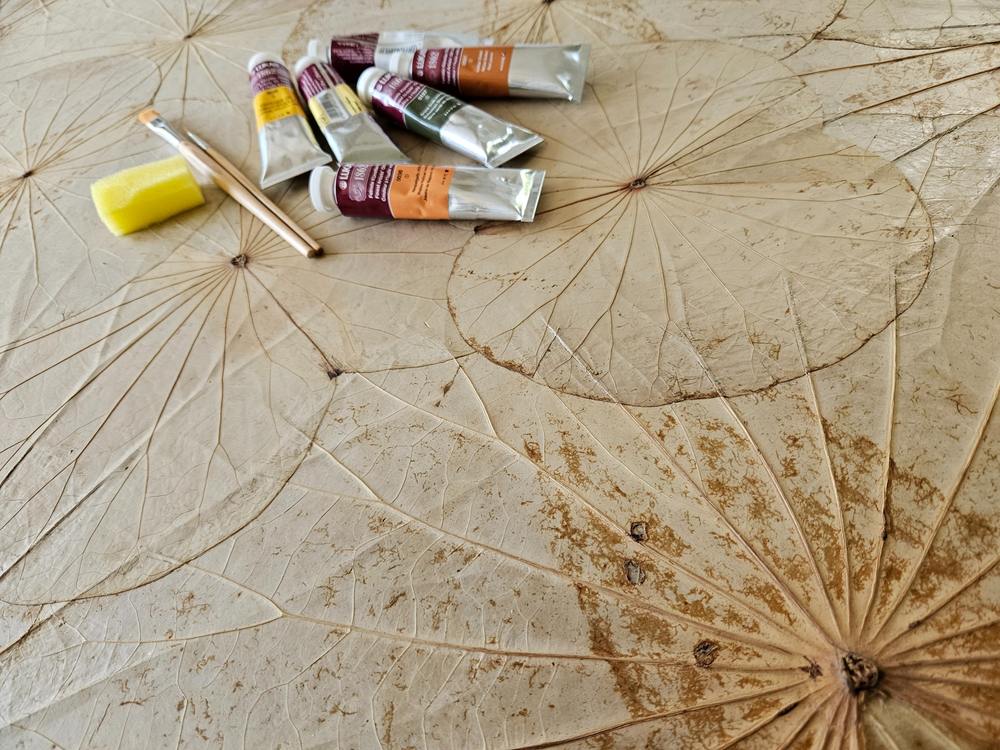
The first thing you notice is not the paint. It is the leaf. A real lotus leaf, the size of a dinner plate or bigger, with fine veins running out from the centre like the spokes of a wheel. It has been dried, pressed and stretched on a wooden frame, and it looks delicate and surprisingly sturdy at the same time.
That is what you paint on with Kirsten. Her workshops go by the name Himapan Berlin, which sounds like somewhere far away. That is the point.
What lotus leaf painting is
In lotus leaf painting the leaf itself is the canvas. The leaves are harvested in Thailand and preserved so that they can be stretched on a frame without tearing. Then you paint on them, and the paint settles into the texture of the leaf. The veins stay visible, so every picture carries a pattern you could never plan.
In Bangkok the technique is taught in workshops under the very name Kirsten uses: Himapan. Thailand is not the only place where leaves become pictures. In Vietnam, too, craftspeople make pictures from lotus and bodhi leaves, preserving them with limewater, sunlight and a lot of patience. Leaves as a surface for art are not an oddity in Southeast Asia; it is an idea that has grown up in more than one place.
Why the lotus
Few plants carry as much meaning in Asia as the lotus. In Thailand you find it everywhere: in temples, in painting, in sculpture, in ceremonies.
The meaning comes from Buddhism. The lotus is rooted in mud, grows up through murky water and opens its flower above it, clean and untouched. In one of the old discourses the Buddha compares himself to such a flower, rising from the water and unstained by it. Ever since, the lotus has stood for purity, for clarity, for waking up in the middle of a messy world. The Vietnamese monk Thich Nhat Hanh put it in four words: no mud, no lotus.
Nobody painting on a lotus leaf thinks about this all the time. But it is there, somewhere between the veins.
The name: Himapan, the forest at the foot of the world mountain
Himapan, often spelled Himmapan, is a place that does not exist. In Thai Buddhist cosmology it is a legendary forest at the foot of Mount Meru, the mountain at the centre of the universe, described in the Traiphum, an old Thai text about the three worlds. The Himapan forest is home to creatures that are half one thing and half another: nagas, the serpents of the water; garudas with the heads of birds; kinnaris, half woman and half bird.
You still see them on Thai temples and palaces today. A forest full of imagination and colour: a fitting name for a kind of painting where you never quite know what will end up on the leaf.
How Kirsten found it
Kirsten has always painted, much of it in acrylic. About three years ago she took part in a lotus leaf painting workshop run by a woman who had lived in Asia for a long time and was looking for someone to take over her workshops.
Kirsten thought it would be a shame to let such a rare craft simply disappear. So she decided to carry it on, alongside everything else she does. She could not take over the atelier itself: it was in the south of Berlin and she lives in the north. So she turned the idea around. Instead of a fixed room, she now brings everything with her and comes to the group.
Practically nobody offers this kind of painting in Germany. Apart from Kirsten there is one other person, in the Harz mountains, who learned from the same teacher. It is rare in the rest of Europe, too.
The material: a work of art before the first brushstroke
The lotus leaves are harvested fresh in Thailand. Then comes a process of about three weeks whose exact recipe is a secret. Most likely a solution similar to glycerine is involved, so the leaves stay supple and do not break. After that they are dried and pressed.
They are mounted on hand-made wooden frames from an atelier in Bangkok. You cannot buy these frames in Germany; they come by ship. Kirsten tried making them herself. It did not work. “The frame alone is a work of art,” she says.
How you paint
If you are picturing watercolour or canvas, prepare to be surprised. You do not just paint on the leaf, you work the paint into it: with a sponge, with your fingers, layer by layer. It is slow, and that is exactly the appeal. You sink into it. Kirsten sees it again and again: people who arrive restless go quiet after a while.
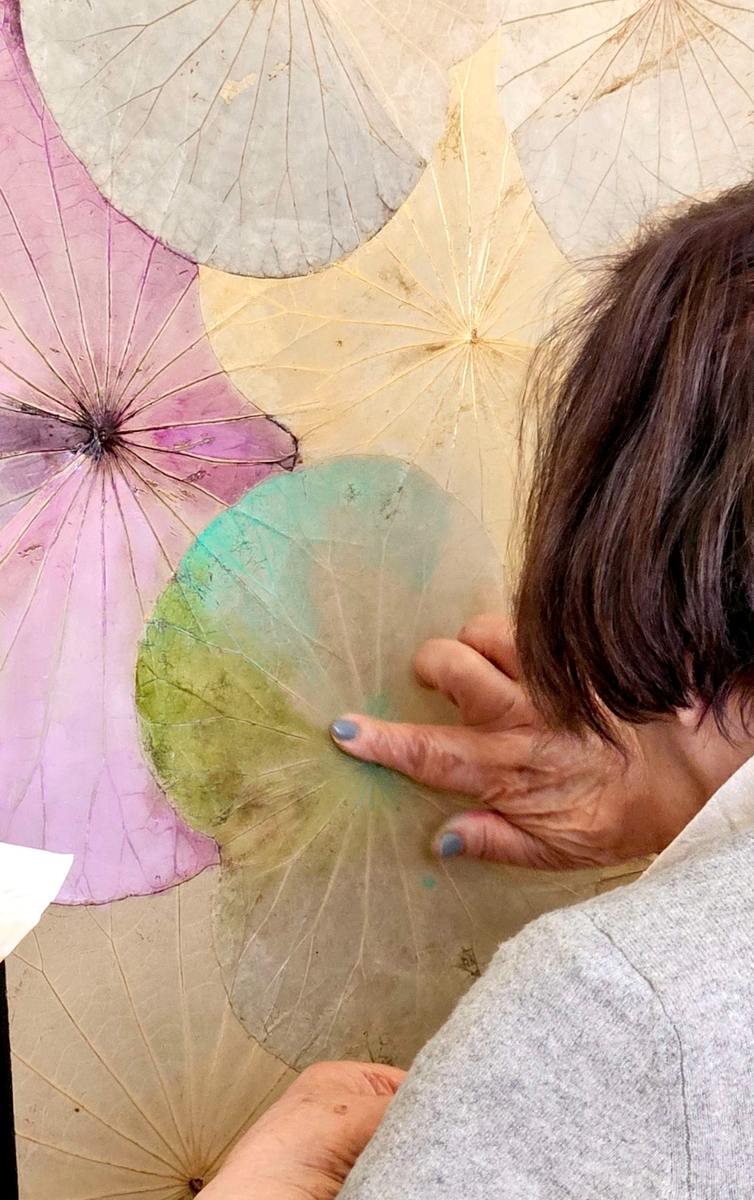
No talent needed. With her guidance everyone goes home with a beautiful picture. The smallest format, 40 × 40 cm, takes three to four hours. Larger formats can take several days.
And not everyone has to paint their own. At an event in the Gärten der Welt, thirty to forty visitors worked on one single picture, one pair of hands after another. For a team that is a lovely idea: one shared picture that ends up on the office wall.
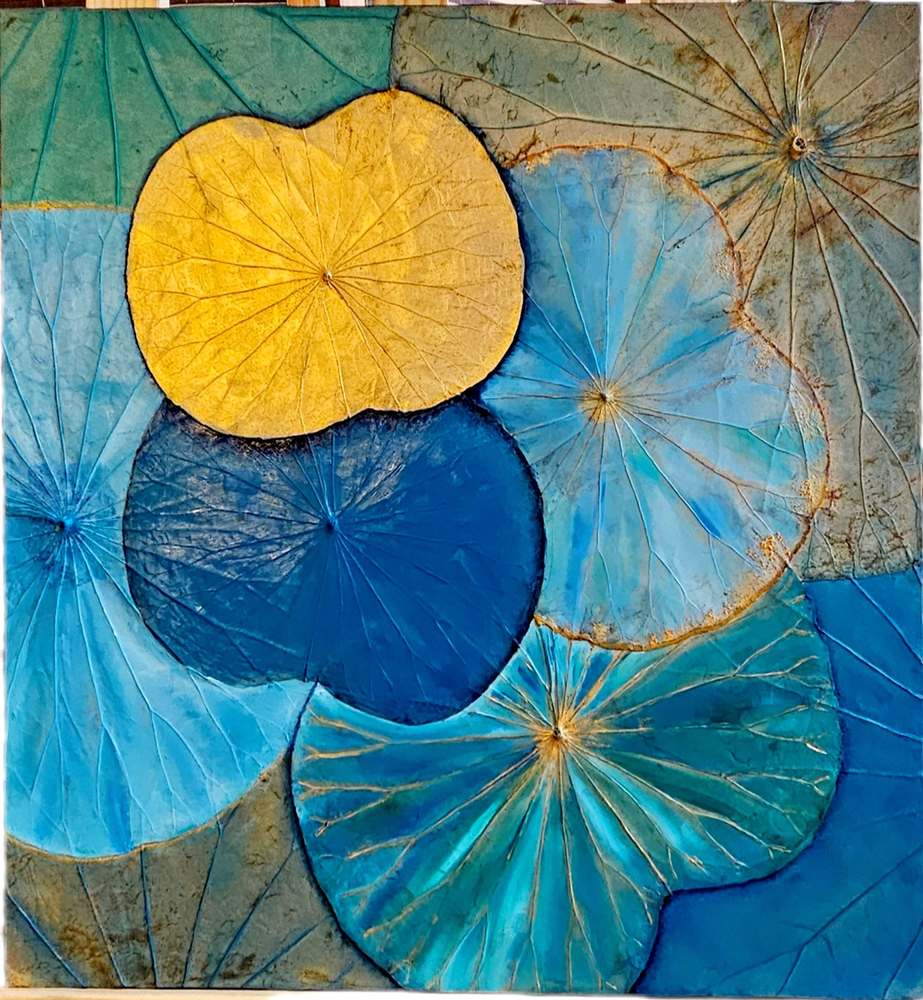
For your team, your friends, your living room
A workshop is for 2 to 8 people and is taught in German. It costs €135 per person for the 40 × 40 cm format, frame and all materials included. Kirsten comes to you, at the office, at home or anywhere else, and brings everything. You arrange the date with her directly.
If you would like to see her work first: Kirsten also sells her own lotus leaf paintings, and some are on show in Prenzlauer Berg right now.
Lotus leaf painting, wherever you are
Kirsten's page has everything at a glance. Send us your preferred date and group size from there and we will set it up with her.
One afternoon, one leaf from Thailand, hands full of paint. And at the end, a picture that exists exactly once.